
Flagstaff City Directory Holdings
Flagstaff’s main city directory run is held by the Flagstaff City-Coconino County Public Library and shared online through the Arizona Memory Project. The library describes digitized Flagstaff directories from 1929 through 1986, with missing years. Catalog work also found a 1989 Johnson directory. That later item is evidence of one more surviving book, not proof that 1989 was the final print year. The books also change shape over time. Some are city directories, some are telephone books, and several cover nearby places such as Williams, Winslow, Sedona, Oak Creek, or the Grand Canyon. Check the geographic heading on every scanned page before assigning an entry to Flagstaff.
| Collection | Years or Examples | Where Held | Access |
|---|---|---|---|
| City and telephone books | 1929-1986 with gaps; 1989 item | Flagstaff library and Arizona Memory | Free scans where rights permit; library copies |
| NAU yearbooks | Pine 1915-16; La Cuesta 1917-68 | NAU Cline Special Collections | Digital and special-collections access |
| Newspapers and obituaries | Index 1883-2004; text from 2005 | NAU Cline and public library | Archive help and library databases |
| Sanborn maps | Seven editions, 1890-1948 | Library of Congress and library | Free digital gallery and catalog |
The gaps matter. A missing name can reflect an absent volume, a skipped listing, changed spelling, a move beyond that edition’s coverage, or a household listed under someone else. It does not by itself prove that a person left Flagstaff. Confirm the year and scope before drawing a conclusion.
Flagstaff Directory Years and Publishers
The known Flagstaff shelf begins with the 1929 Directory of Flagstaff from The Coconino Sun. Mountain States Telephone and Telegraph produced books for 1935-36 and 1936. Johnson Publishing appears in 1948-49 and 1955, while the 1961 book combines Mullin-Kille material with a Johnson part. A 1971 Mountain States white-pages volume and Johnson books from 1986 and 1989 show how publisher and format shifted. Johnson reported its first city directory as 1932, which sits beside the earlier newspaper directory rather than replacing it.
This mixed publication history explains why a single search method fails. Alphabetical pages lead from a surname to an address. A telephone locator reverses a known number to a subscriber. The Street and Avenue Guide or street-number section runs from an address to a listed person or firm. Classified pages supply trade context. Each route can expose a match missed by optical character recognition, especially when initials, abbreviations, or worn type confuse the scan.
Note: The library’s 1929-1986 statement includes gaps, so never describe the Flagstaff city directory run as annual or continuous.
Accessing Flagstaff City Directories
The Flagstaff library local-history collection is the first access channel for directory books and linked databases. Downtown Library is at 300 W Aspen Avenue and can be reached at 928-213-2330. Its researched hours are Monday through Thursday 9 a.m. to 8 p.m., Friday 9 a.m. to 6 p.m., Saturday 9 a.m. to 5 p.m., and Sunday 9 a.m. to 1 p.m. East Flagstaff Library, 3000 N Fourth Street, Suite 5, is another staff-help route at 928-213-2348. Confirm hours before travel.
The digital doorway is helpful when a visit is not practical. The library’s online local-history page shows the available resources and describes the directory span. The page below gives a visual check of that official starting point.
Open the library’s Flagstaff local-history databases page before choosing a year or companion source.
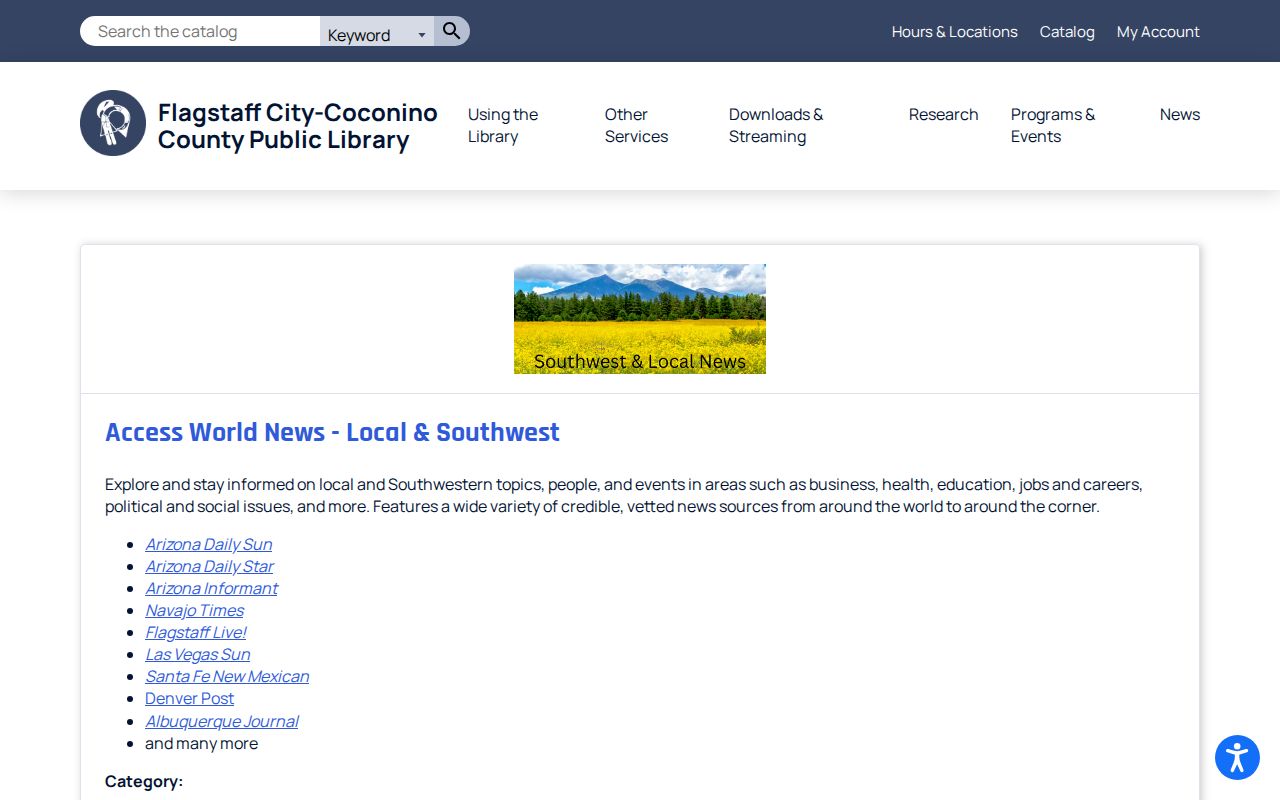
The captured library page helps distinguish the local collection from unrelated statewide databases and points researchers toward staff-supported access when a scan is absent.
Decode a Flagstaff Directory Entry
A Flagstaff city directory entry compresses several facts into one short line. The 1971 and 1979 pages inspected in the research place the surname first, followed by given name or initials. A spouse may appear in parentheses. Occupation, title, employer, street or neighborhood, unit, and telephone number can follow. Those elements describe what the publisher printed for that edition. They do not prove that every person with the same surname shared one household, even when their lines sit next to each other.
| Name form | Surname, given name, and initials as printed or supplied |
|---|---|
| Spouse notation | A spouse may be shown in parentheses beside the listed person |
| Work clue | Occupation, title, or employer may link the entry to another archive |
| Place clue | Street, neighborhood, address, or unit ties the entry to one edition |
| Telephone | A listed number may be checked through the book’s number locator |
Photograph or save the abbreviation key with the entry. Then inspect the scan, not OCR alone. The research found OCR examples with spouse details, student or engineer roles, city work, Campus Heights units, and other compact clues that can be misread when punctuation drops out.
- Criss-cross directory
- A later directory section arranged by street address or telephone number instead of surname.
- Householder index
- An address-oriented list that identifies the person or firm printed for a dwelling.
- Abbreviation key
- The volume’s legend for short forms used in names, work, residence, and street entries.
Three Flagstaff Directory Search Paths
One surviving volume can answer three different questions. Start with the alphabetical pages when the person’s name is known. Use the telephone locator when an old bill, letter, or photograph supplies only a number. Turn to the Street and Avenue Guide when an address is the surest clue. The 1989 Johnson directory is a clear late-print example because it combines alphabetical city pages, a number locator, classified businesses, and street lookup in one work.
That three-way structure is a Flagstaff directory quirk worth using. It also guards against a weak assumption. A failed surname search does not end the inquiry if the same household appears under a spouse, initials, a changed surname, or a business listing. Search Spanish surnames with both one-surname and two-surname forms. Try initials found in older telephone books. When OCR fails, browse the page range by hand and compare the printed image.
Trace Families in Flagstaff Directories
A year-by-year trail is strongest when every claim stays tied to a page image. Begin with one year in which the name or address is already known. Record the exact printed spelling, spouse, work clue, phone, and address. Move to the closest earlier and later available books, noting both changes and missing volumes. Census records can then fill a broader household frame. The 1950 census is the latest fully public decennial census as of 2026 under the federal 72-year access rule.
- Choose a benchmark directory year and search the surname plus likely variants.
- Save the scan and its abbreviation key, then capture the complete entry.
- Check adjacent available years for moves, work changes, or a new spouse notation.
- Use the street guide to test the address and identify other separately listed occupants.
- Compare the nearest public census, deed owner, obituary, and newspaper event.
Directory and census geography do not always match. Some books reach beyond Flagstaff, while census enumeration may include unincorporated areas associated with a Flagstaff mailing address. A careful timeline names the source and year instead of treating every location label as the same boundary. Modern one-person verification belongs in the Flagstaff resident lookup, where current official indexes have different rules.
Extend a Flagstaff Directory Trail
Several local collections fill years or voices that household directories miss. NAU Cline Special Collections holds Pine for 1915-16 and La Cuesta for 1917-68, spanning Northern Arizona Normal School, the teachers college, Arizona State College, and NAU name eras. Its obituary index covers the Arizona Champion and Coconino Sun from 1883 through 2004. The public library’s Arizona Daily Sun database provides searchable text from May 1, 2005 and replica images from April 1, 2023.
NAU’s Building Timeline Collection #329 adds eight linear feet of newspaper research organized by address, building, and owner. Historical property surveys document more than 1,000 Flagstaff buildings. These sources add construction, ownership, organization, and event context without pretending to name every occupant. Manuscript collections also contain lumber-company files, time sheets, club directories, church records, and an 1895 fire-company membership roll. Only a fraction is online, so contact or appointment work is often required.
Note: Yearbooks and club rolls can identify a person in a past setting, but they do not provide present contact information.
Flagstaff Stories Beyond Directory Pages
Los Recuerdos del Barrio preserves oral histories and photographs from more than 40 Spanish, Basque, Mexican, and Mexican-American Flagstaff families. Their accounts connect local lives to railroad, lumber, sheep, grocery, and Navajo Ordnance Depot work. This collection matters because a printed directory reflects the publisher’s rules and the household information available at one moment. Oral history can preserve relationships, migration, work, and community memory that a terse name-and-address line leaves out.
The broader Arizona Historical Society and NAU holdings include manuscripts, diaries, letters, photographs, sound and moving images, microfilm, maps, books, and digital files. Many require on-site research and some carry access restrictions. Treat the printed directory as an index into that richer record, not as a complete account of who belonged in Flagstaff.
Close Flagstaff Directory Timelines
A person who disappears from later city directories may have moved, died, changed names, joined another household listing, or simply gone unlisted. Cemetery and obituary records help test one of those paths. The City of Flagstaff supports family research at Citizens Cemetery and links a burial locator. Staff also accepts family-research questions by email or fax and states a five-business-day response. The library Cemetery List covers cemeteries and plots inside city limits through 2009.
Visit the Flagstaff Citizens Cemetery family-research page for the city’s research channel and contacts.
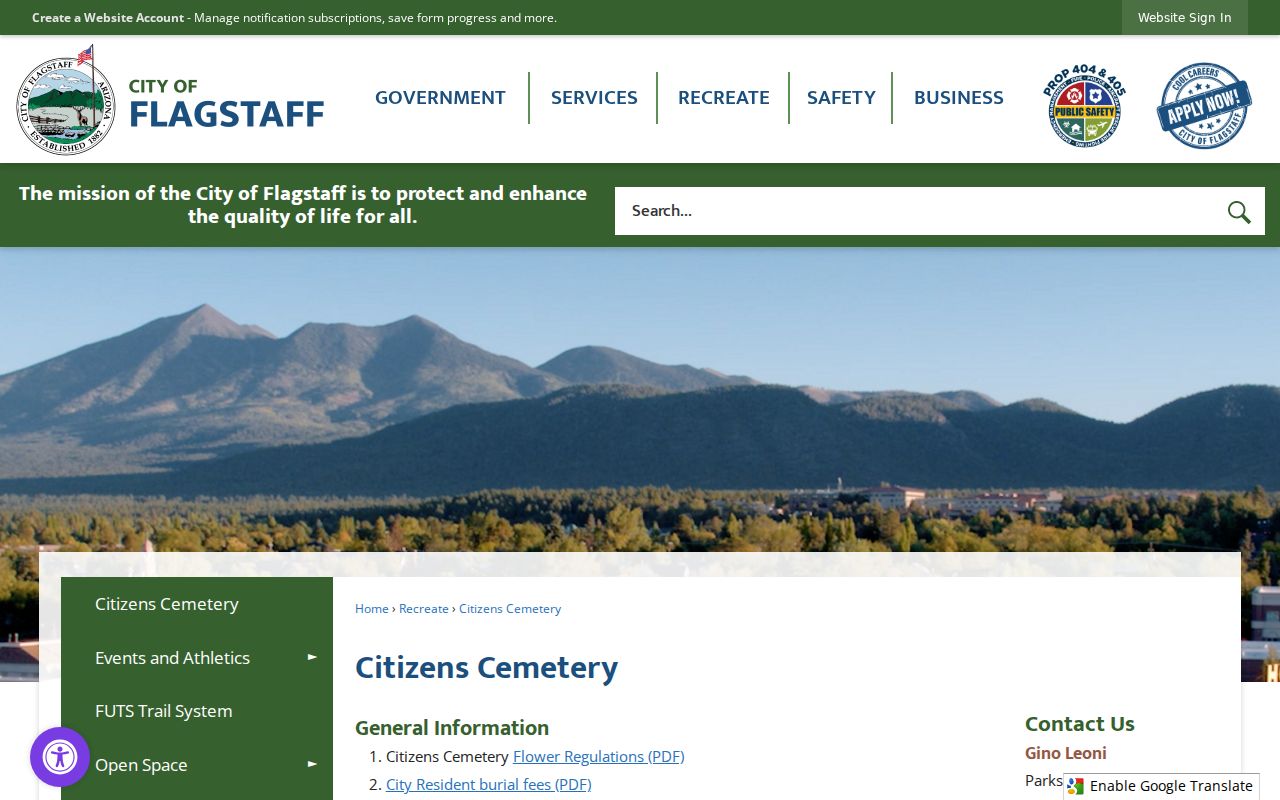
The city page shows why cemetery staff and maintained records are stronger endpoints than assuming a missing directory entry means death.
Check Flagstaff Directory Endpoints
The linked Citizens Cemetery burial locator provides the online search route when a directory trail may end at the city cemetery.
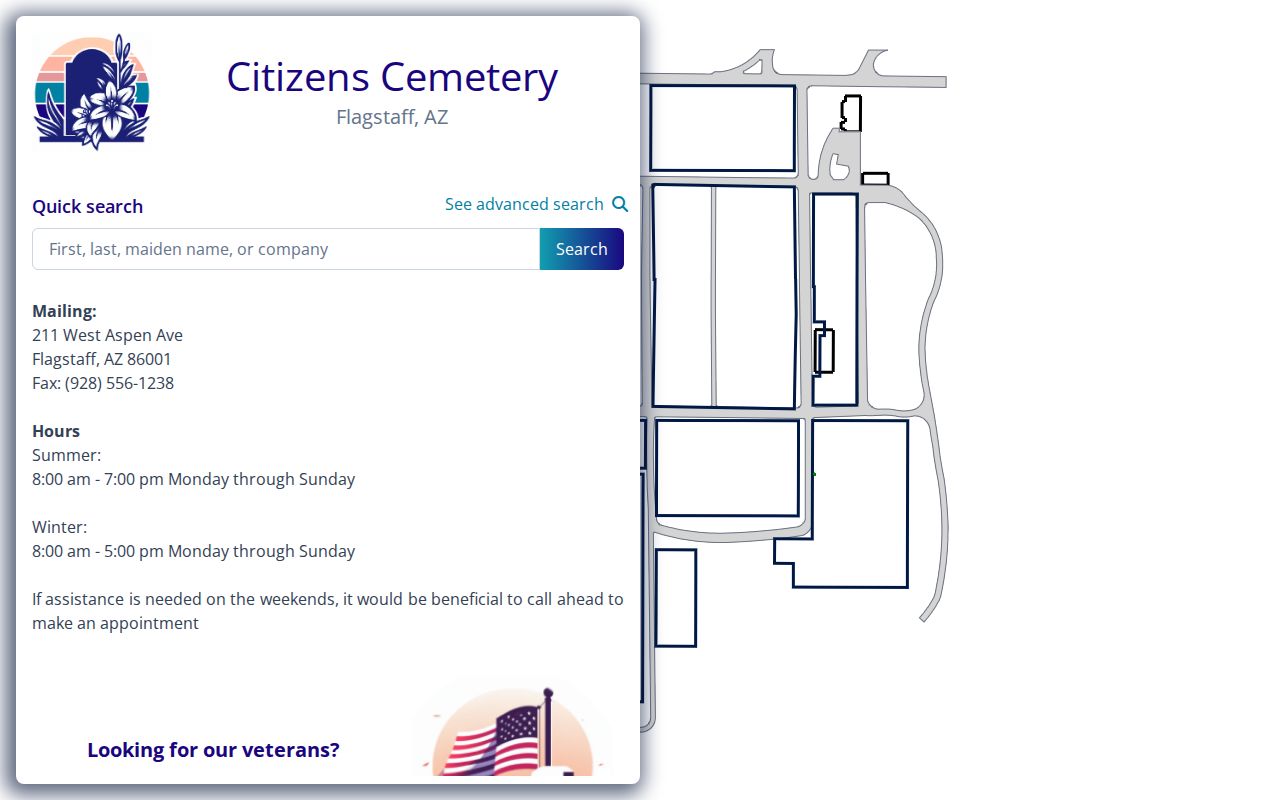
A locator match should be reconciled with the directory name, dates, obituary, and any vital or court record needed for the research purpose.