
Flagstaff Resident Lookup Sources
Each official source confirms a narrow part of a person’s trail. The Coconino County Assessor identifies the owner or vesting name tied to a parcel and a tax-mailing destination, but not every occupant. Recorder documents identify named parties to recorded transactions. Arizona court indexes expose public case leads, while local clerks hold the official files. Historical vital images can confirm older life events after their statutory access periods. Business and license records show public affiliations, and those addresses may belong to an entity or agent rather than a home.
| Record | What It Confirms | Where | Access |
|---|---|---|---|
| Assessor roll | Owner name and tax-mailing destination | Coconino County portal | Public; not occupancy proof |
| Recorded documents | Named transaction and legal-address clues | County Recorder | Name index from 1981; older books at office |
| Court case index | Party role, case event, and disposition lead | Arizona courts and local clerk | Public index with exclusions |
| Vital genealogy index | Eligible historical birth or death fact | ADHS and State Archives | Free noncertified images after statutory period |
| Business or license filing | Entity, agent, principal, or credential tie | ACC, SOS, or issuing board | Public filing; address role varies |
| Unclaimed property | Historical name and address association | Arizona Department of Revenue | Search and claim are free; proof required |
Choose the first source based on the question. An address can lead to an owner record. A case number leads to a court. A death or birth in the public genealogy period belongs in the historical index. Keep each source’s role in view throughout the Flagstaff resident lookup.
Control Same-Name Flagstaff Lookup Errors
A common surname and city match are not enough. Build a small identity table before joining records. Record the exact full name and initials, the time period, every known address, spouse or relative, public affiliation, and the role the person plays in each record. An owner, court party, registered voter, business principal, and directory listing can refer to different people with the same name. Require at least two independent facts to agree.
Search spelling variants with care. Older Flagstaff telephone books often reduce given names to initials. Spanish names may appear with one surname, two surnames, changed order, or OCR errors. Court spelling comes from the originating court and aliases may be incomplete. If an official source conflicts with a copied listing, ask the actual custodian about correction. Changing a downstream compilation does not repair the court, Recorder, or assessor record.
Match rule. Two records containing the same name are leads, not identity proof; compare time, address, role, and another independent detail.
Search Flagstaff Resident Court Records
The Arizona Public Access Case Lookup covers 177 of 184 courts and updates Friday with information through Wednesday. A verification-text gate appears before search. A party name or case number can start the query, and a court dropdown can narrow results to Coconino County Superior Court. Advanced controls add AND, OR, and NOT operators. The index is free, but it is not the official court record.
| Search Control | Input | Required | Use |
|---|---|---|---|
| Verification text | CAPTCHA text | Yes | Passes the search gate |
| Party Name | Full or partial text | Alternative | Finds indexed spellings from the court |
| Case Number | Full or partial text | Alternative | Targets a known case |
| Select a Court | Dropdown | No | Narrows an all-courts search |
| Advanced Search | Expanded criteria | No | Combines criteria with operators |
The result may show court, case number, type, filing date, status, indexed party and role, public charges or claims, disposition, event dates, judge, and location. It omits sealed matters, orders of protection, mental-health cases, probate, victim or witness data, juvenile delinquency matters, and local-ordinance charges. A docket is the dated list of events and filings in a case, not a full document set.
The Arizona eAccess service requires registration and offers eligible Superior Court civil and criminal documents filed on or after July 1, 2010. Documents, subscriptions, and electronic certification carry charges. The captured eAccess page shows that separate document route.
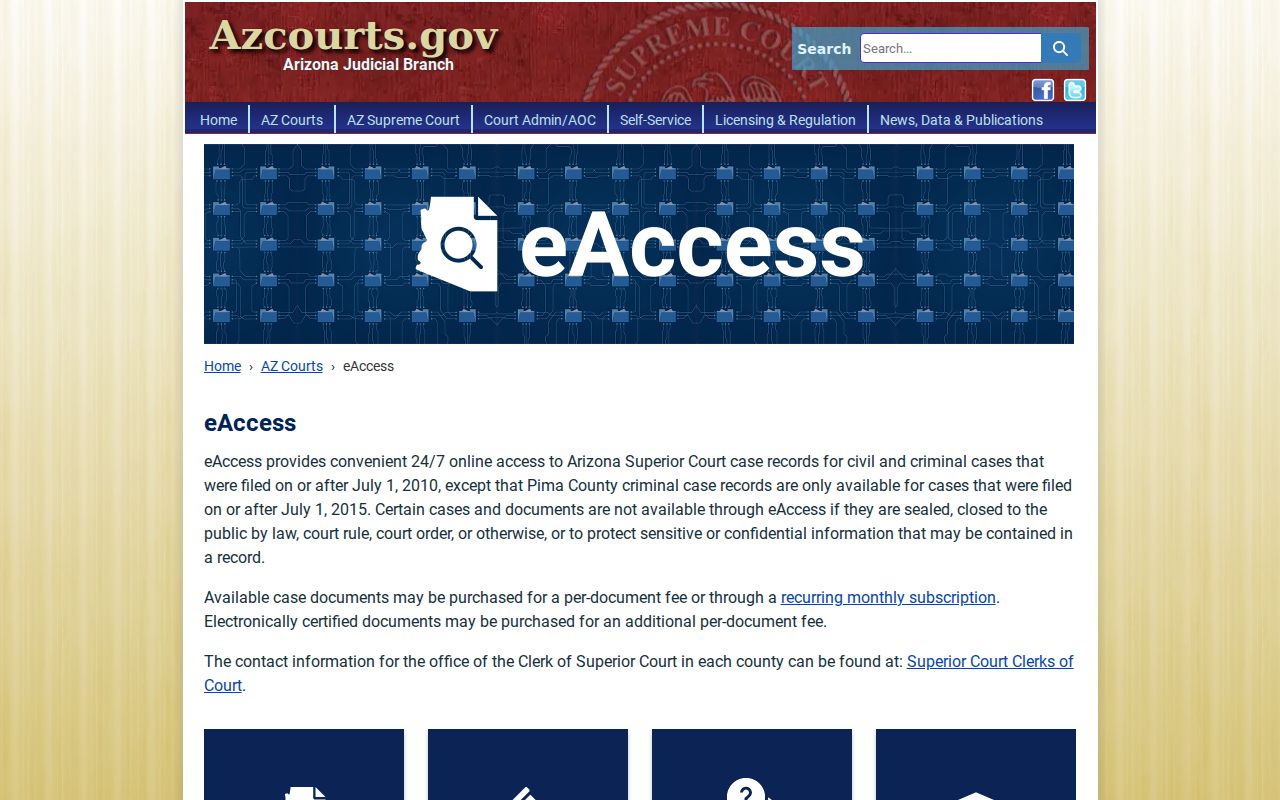
The account-based screen is a reminder that Public Access data and purchasable court documents are separate services. For an official file, an archived case, or probate, contact the Coconino County Superior Court Clerk.
Verify a Flagstaff Resident Match
Run one verification task in a set order. Start with the fact least likely to belong to another person. An exact parcel or known case number is stronger than a common name. Separate a property’s site address from the tax-mailing address, since neither proves who occupies the building. Then compare name variants across the Recorder and court index. Use a historical vital image only when the event falls within public access and the people, place, and date align.
- Write the known name, date range, address, relative, and record role in an identity table.
- Anchor the name to an official parcel, recorded document, entity, or known case number.
- Search the court index for exact and plausible name variants, then narrow by court.
- Compare two independent facts before treating results as the same person.
- Request the official file or certified copy from its custodian when proof is needed.
- Docket
- The court’s chronological list of case events, entries, and filed documents.
- Index versus image
- An index points to a record; an image reproduces a document and may have separate access rules.
- Certified copy
- A custodian-issued copy formally attested as a copy of its official record.
Flagstaff Lookup Through Vital Records
Arizona draws a firm line between public genealogy and recent certified records. Under A.R.S. §36-351, birth records transfer for public archival access after 75 years and death records after 50 years. The Arizona genealogy search provides free historical images, but those images are noncertified. The statutory age of the record controls eligibility for archival release, not a portal’s last displayed year.
The official historical search screen below is the right channel for an eligible birth or death event.
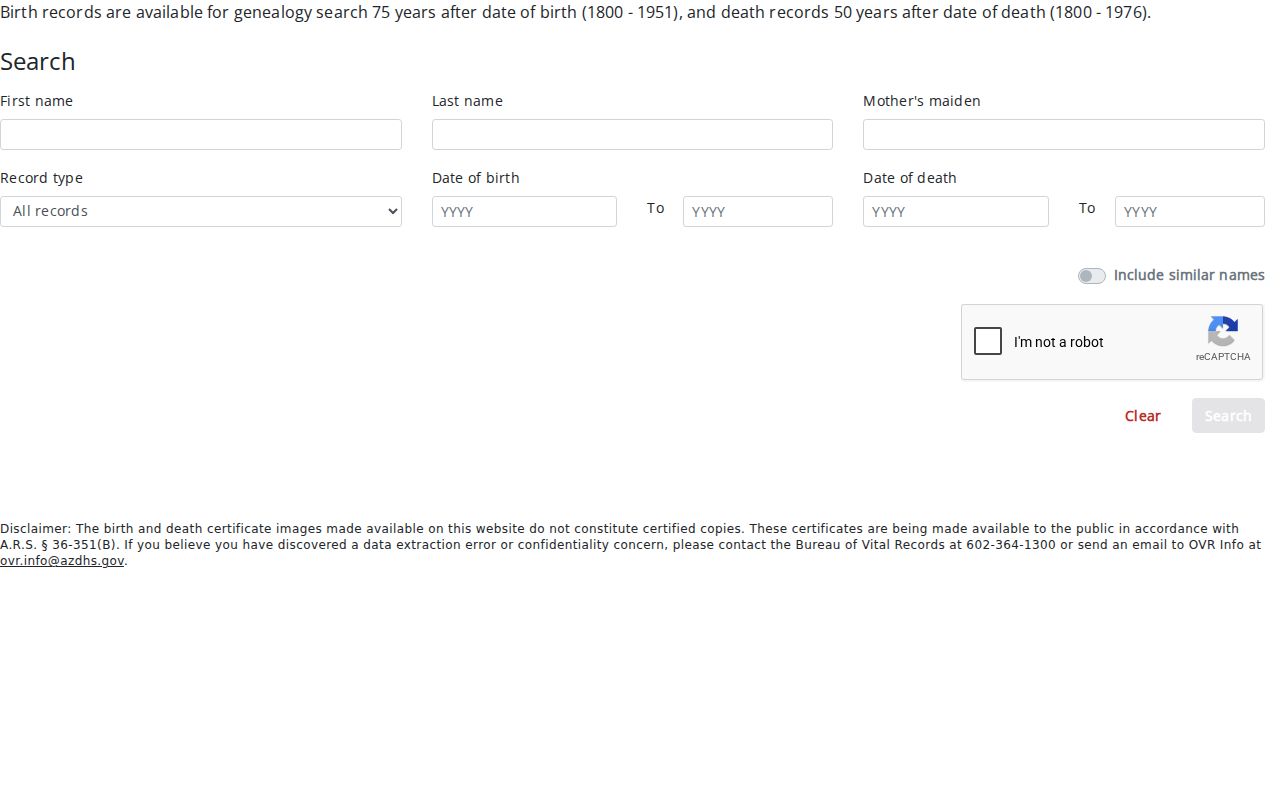
The genealogy portal can confirm an older life event, while recent certificates still require the state or county application, identification, relationship proof, and eligibility.
Coconino County Health and Human Services Vital Records is at 2625 N King Street in Flagstaff and can be reached at 928-679-7325 or 877-679-7272. A current certified birth or death copy costs $20. Mail requests need the stated documents, payment, original signature, and a self-addressed stamped envelope. Arizona does not issue state marriage or divorce certificates. Marriage licenses and divorce decrees come from the Coconino County Superior Court Clerk.
Flagstaff Voter Lookup Boundaries
The Arizona Voter Information Portal is an authenticated self-lookup for registration, districts, ballot status, and participation. It is not an open Flagstaff people directory. A.R.S. §16-168 limits public voter-file use to political, election, redistricting, and other statutory purposes, while sensitive identity fields remain withheld. A resident lookup must not treat that protected file as a street list or use the self-service portal to search someone else.
Coconino County does offer one unusual historical exception for a defined purpose. Its Downwinder Records Request can retrieve voter registration or property evidence of residency during 1952 through 1964. That written archival request helps document a past residence for qualifying historical research. It does not make current voter information generally open. The distinction preserves a valuable human-use path without breaking modern voter privacy.
Note: If a voter result seems absent, first check whether the requested use and access channel are lawful before assuming the resident is missing.
Confirm Flagstaff Business Affiliations
Arizona divides business records between agencies. The Arizona Corporation Commission, not the Secretary of State, indexes corporations and LLCs. ACC eCorp can search by entity name, statutory agent name, principal name, or entity ID, with optional type, status, name-type, and county filters. A result can show entity name and ID, status, formation dates, statutory agent, principal office, principals and titles, and document history. Those are public business ties. An agent or office address is not automatic evidence of residence.
The Secretary of State handles UCC, notary, and optional trade-name or trademark records. UCC searches accept a filing number, debtor name, or secured-party name. The notary tool can filter active commissions by county or ZIP. Trade-name records can supply registrant and public contact fields. For licensed activity, the Arizona professional-license hub routes a search to the proper issuing board. Always confirm status with that board rather than relying on an old directory entry.
Official Flagstaff Safety Lookup
The Arizona Department of Public Safety provides the official entry to the state sex-offender registry. It publishes the data required for qualifying registrants and risk levels, but it is not a complete list of all convictions. Its role is public safety. A match should be checked against the official registry record, and no listing gives permission to threaten, intimidate, contact, or harass a person.
Use the Arizona DPS registry entry page to reach the official search and read its restrictions.
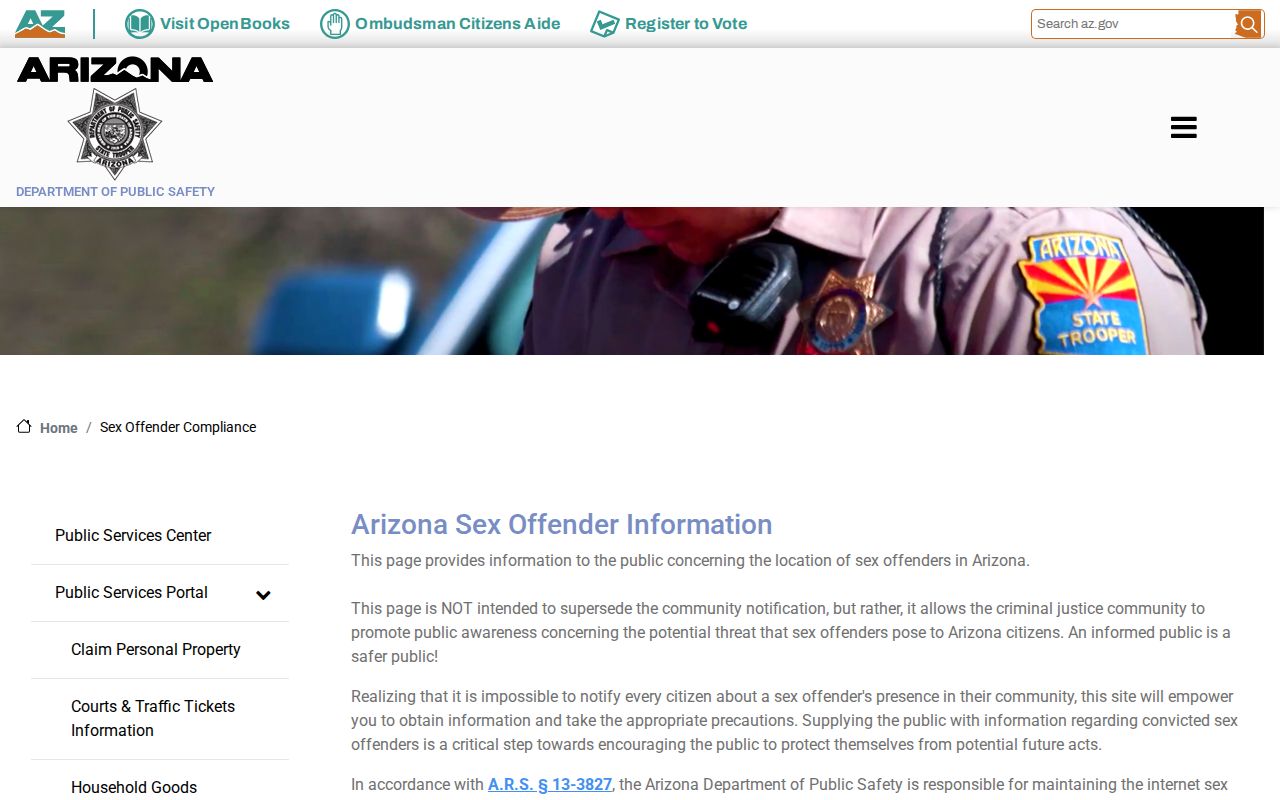
The state entry page keeps the lookup tied to its safety purpose and current warnings instead of detached copies that may omit context.
Legal Limits on Flagstaff Lookups
Some gaps are intentional. Arizona’s Address Confidentiality Program gives qualifying victims a substitute address and confidential mail forwarding. Agencies must accept it for home, work, and school records. Related restriction and redaction procedures can affect Recorder, Assessor, Treasurer, voter, and motor-vehicle records. Recent vital certificates, sealed cases, adoption and juvenile matters, protective records, motor-vehicle data, and utility subscriber data also have legal limits.
When an administrative record is public but no portal exposes it, send a focused request under Arizona Public Records Law, A.R.S. §§39-121 through 39-128, to the agency that keeps it. Identify an existing record series, subject, date range, and desired format. Arizona requires records to be furnished promptly but sets no automatic three-, five-, or ten-day deadline. If a record is closed or not retained, preserve that answer instead of filling the gap with an unsupported claim.
Lawful use. A Flagstaff resident lookup is for lawful personal research. Never use records to stalk, harass, threaten, or harm anyone.