
Flagstaff Previous Resident Eras
A backward address trail works best when the question is matched to the right era. Current parcel records establish today's land identity. Recorder instruments follow legal ownership. Directories and census schedules can name people tied to the place at a date. Maps, archive clippings, surveys, and permits explain the building and its setting. None should be stretched beyond what it records.
| Source | Years it covers | Where held | What it shows |
|---|---|---|---|
| Recorder online name index | January 1981 to present | Coconino County Recorder web search | Indexed deeds, liens, parties, dates, and instrument references |
| Recorder books and microfilm | Before 1981; county records from 1891 | Recorder office and archives | Grantor-grantee and docket/page trail |
| Flagstaff directories | 1929-1986 stated run with gaps; 1989 item found | Public library and Arizona Memory Project | Listed resident or business, address, telephone, and sometimes occupation |
| Federal census | Useful public schedules from 1900 through 1950 | NARA and genealogy access | Household at an enumeration date |
| Sanborn maps | 1890, 1892, 1895, 1901, 1910, 1916, 1948 | Library of Congress and library | Building footprint, use, materials, lot, and number context |
| Building Timeline Collection | Collected historic clippings | NAU Cline Special Collections #329 | Address, building, and owner narrative evidence |
| Historic property surveys | More than 1,000 buildings documented | Flagstaff library Arizona Memory Project | Architecture, date, and historic context |
| Permits | Verified online start not found | City portal and records request | Construction and inspection chronology |
For a recent transfer, start with the Assessor and Recorder. For past residents in the directory era, use ownership and occupant sources together. For an earlier structure, begin with the lot, plat, and Sanborn sheet, then look for a census household or archive file. Flagstaff became the Coconino County seat after the county's creation in 1891, so pre-1891 research may require territorial or predecessor-jurisdiction records.
Flagstaff Previous Resident Deed Chain
A chain of title follows ownership instruments for the same land. Begin with today's parcel, not a familiar surname. The Coconino County Assessor supplies the current owner, parcel number, situs, and legal description. The Coconino County Recorder then supplies the named transactions. Matching the legal description at every link guards against joining two similarly named people or two different Flagstaff properties.
- Save the current parcel number and full legal description from the Assessor and GIS views.
- Find the current owner's purchase deed. Record the grantor, grantee, recording date, instrument number, and exact land description.
- Search the seller, or grantor, as an earlier grantee. Confirm that the earlier purchase concerns the same lot before adding it to the chain.
- Repeat through the online name index to January 1981. Use date, document type, docket/page, subdivision, lot, block, or tract to cut false matches.
- Cross the web cutoff with alphabetical index books, microfilm, and docket/page references at the Recorder office.
The legacy portal says its official-record index begins in 1983, while newer county material describes 1981 to present. Both agree that most linked images are available from March 29, 1999. Treat 1981-82 as a range to verify with staff. Plain copies cost $1 per page, and certification adds $3 per document. Copies may be requested online, by mail, or in person at 110 E Cherry Avenue.
- Grantor
- The person or entity transferring an interest in a recorded instrument.
- Grantee
- The person or entity receiving that interest. The prior owner often appears as a grantee on an earlier acquisition.
- Chain of title
- The linked series of ownership transfers for the same land.
- Legal description
- The land identity based on lot, block, subdivision, or survey terms. It can survive a street-name or number change.
Flagstaff Previous Residents Before 1981
When the web name index stops, the trail does not. Recorder indexes were organized chronologically and alphabetically by name or docket/page. Those older books and microfilm are the bridge. Phone or email staff before a visit with the party names, rough transfer span, legal description, and any book, page, or instrument clue already found. The office cannot interpret legality or prepare an instrument, but it can explain inspection and copy access.
Coconino County's 2023-25 preservation project aimed to digitize 1.9 million microfilm images and 420 vault books. A $1 million federal grant and $507,849 match also supported server and disaster-recovery work. In May 2025, the Recorder reported continued scanning and a new Archives Technician. Coverage may improve, so recheck the web search before concluding that an early deed is counter-only.
Note: March 29, 1999 marks a document-number transition and broad PDF availability; it should not be retold as a records-loss date.
Pair Flagstaff Directories and Census
Ownership is only half of a previous-residents search. A street-and-avenue guide can tie a listed person or business to a house number in a specific directory edition. Alphabetical pages may add a spouse, occupation, employer, telephone, or unit. The federal census can show a fuller household at its enumeration date. Public census access follows the 72-year rule, making 1950 the latest fully open decennial schedule as of 2026.
- Choose the address and a benchmark year from a deed, permit, map, or known family event.
- Search the directory's street guide, then confirm the same name in its alphabetical pages. Check the printed geographic heading.
- Move to nearby directory editions. A missing year or missing listing does not prove the household moved.
- Compare the address and names with the nearest public census schedule. Account for enumeration geography beyond the directory's city coverage.
- Test the combined result against deed ownership, newspaper events, and probate rather than treating one shared surname as conclusive.
Flagstaff telephone books sometimes include Grand Canyon, Williams, Winslow, Sedona, and Oak Creek. OCR also mishandles initials, two-surname usage, spouse parentheses, and abbreviations. Inspect the scan itself. Details about publishers and how entries are printed remain with the Flagstaff city directory page.
Map Previous Flagstaff Addresses
Seven discovered Sanborn editions cover Flagstaff: October 1890, December 1892, July 1895, October 1901, October 1910, January 1916, and January 1948. They can show a building footprint, construction material, use, lot context, and street numbering. That evidence helps bridge pre-directory years and gaps between directory editions. It does not identify every person inside.
An old street number may not match a modern Assessor query. Compare the Sanborn sheet with the recorded subdivision plat, lot and block, adjacent cross streets, building shape, and legal description. Research did not locate an authoritative year for one citywide Flagstaff renumbering. A precise but unsupported date would weaken the address chain.
When the structure and lot align, the map can connect an older census or directory address to the modern parcel without pretending the postal label stayed fixed. For a formal boundary issue, rely on the recorded plat or survey rather than an informational map image.
Flagstaff Previous Resident Archives
The Flagstaff Building Timeline Collection is the strongest local substitute for a formal house-history guide. Its newspaper research is arranged by address, building, and owner, making it unusually well suited to a backward trail. The eight-linear-foot collection includes notebooks for residential, commercial, public, religious, military, societies, primitive, and NAU properties.
The NAU Cline manuscript inventory shows the Building Timeline and other resident-related collections captured here.
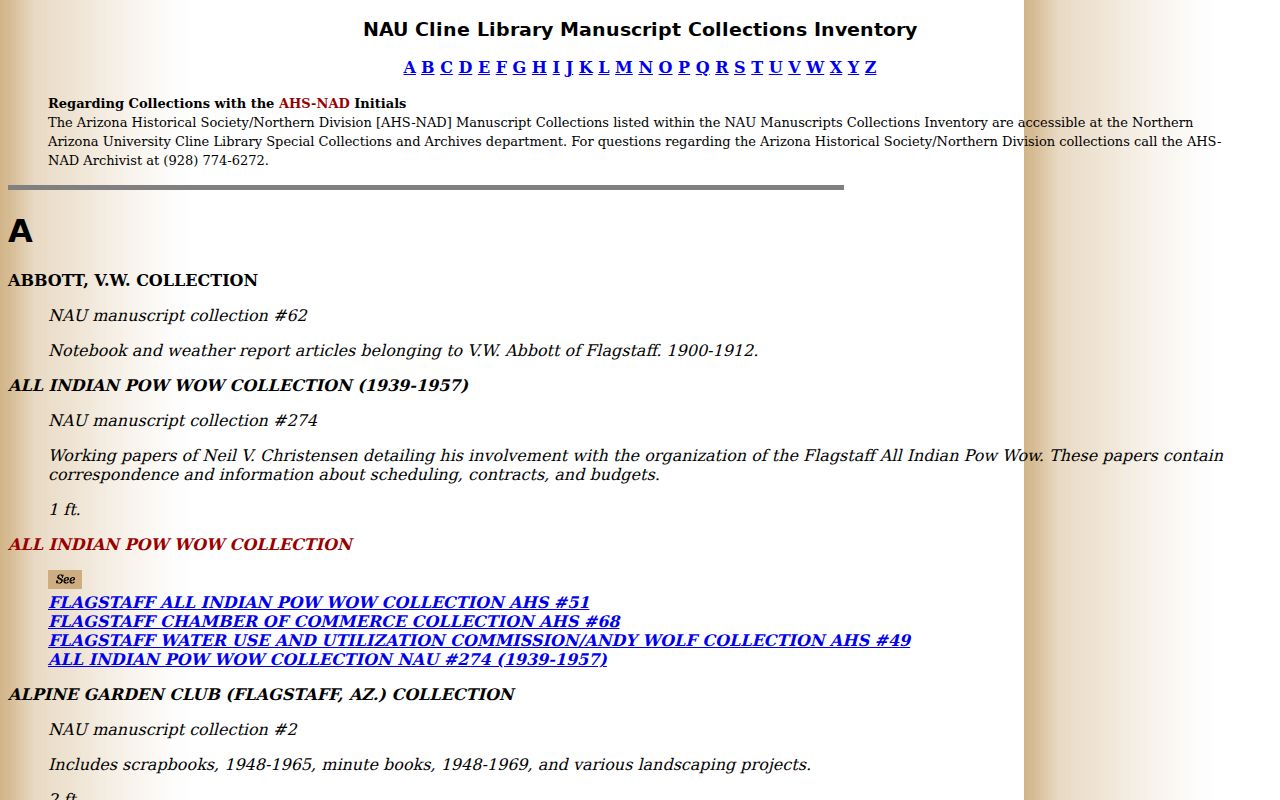
The screenshot points to an archive route rather than a full online house file. Cline Special Collections at 1001 S Knoles Drive is generally open weekdays, and staff recommend contact or an appointment because only part of the holdings is online.
Historic property surveys add a separate layer. More than 1,000 Flagstaff buildings have Arizona State Historic Property Inventory forms. These may establish architectural and date context, yet a survey subject is not automatically a previous resident. Use names from its sources as leads to verify in deeds, directories, and census records.
Flagstaff Previous Resident Permit Clues
A permit can mark construction, an addition, repair, inspection, or final approval. It may name the owner at filing, an applicant, or a contractor. Each role belongs to that dated project. None proves that the named person lived at the site. The official start date of Flagstaff's searchable permit set was not verified, so no broad coverage promise is safe.
Search Citizen Access by the normalized address and likely permit number. If the online result is missing, ask the City for the existing permit or code file under Arizona Public Records Law. Give a narrow date span and record type. Some enforcement or personal details may be withheld or redacted.
Pair the permit date with a change visible on a Sanborn map, property survey, deed, or dated photograph. That can explain when the building changed while keeping the previous-residents question separate from building chronology.
Flagstaff Previous Resident Probate Trail
A deed chain can stall when an owner dies, an estate transfers the land, or heirs act through a personal representative. Search the NAU obituary index covering 1883-2004, then the public library's Arizona Daily Sun access for later years. An obituary can connect family names and a death date, but its address language still needs comparison with the parcel and directory record.
Probate is excluded from the statewide Public Access case lookup. Contact the Clerk of the Coconino County Superior Court for the index, file-inspection, or copy route, and use State Archives for covered historical court records. A probate file may identify a personal representative or heirs and explain a later deed. It should not be used to infer facts beyond the filed record.
Verify Flagstaff Previous Residents
Several traps recur in Flagstaff house research. The tax mailing address may differ from the situs because the owner uses a PO box, an entity address, or another correspondence point. A matching mailing and situs address supports an owner-occupancy clue but does not prove who slept there. A permit applicant may be an agent. A directory may omit a person. A Sanborn sheet dates the place, not the household.
Flagstaff postal geography adds another caution. Addresses labeled Flagstaff can extend into unincorporated Coconino County, especially in 86004, while 86011 functions as NAU's institutional PO-box ZIP. Records jurisdiction follows the parcel and agency, not just the mailing city. Census enumeration geography can also extend beyond what a city directory edition covers.
Lawful use. Research previous residents for house history, genealogy, heirs, or personal curiosity. Never use an address trail to stalk, harass, threaten, or expose a living person.